Seabed Choke Points: The Emerging Doctrine of Undersea Cable Defense
Why global fiber corridors have become primary targets for gray-zone maritime pressure, and how allied naval coalitions are responding.
- •Commercial subsea fiber accounts for over 95% of cross-continental internet traffic, creating severe single points of failure in shallow straits.
- •Physical cable cuts via deliberate anchor dragging operate in a legal gray zone that evades conventional mutual defense triggers.
- •Allied responses are shifting toward decentralized cable paths, AIS dark-vessel surveillance, and shared emergency satellite backup agreements.
The Strategic Reality
Modern geopolitical conflict is increasingly shifting from orbital and air domains to the seabed. Approximately 95% of intercontinental communications and daily financial clearing depend on a global network of roughly 600 operational submarine cable systems.
Recent severed connections in the Baltic Sea, the Red Sea corridor, and the Taiwan Strait have highlighted a structural defense challenge: global digital infrastructure relies almost entirely on commercial assets operating in international waters without military escorts.
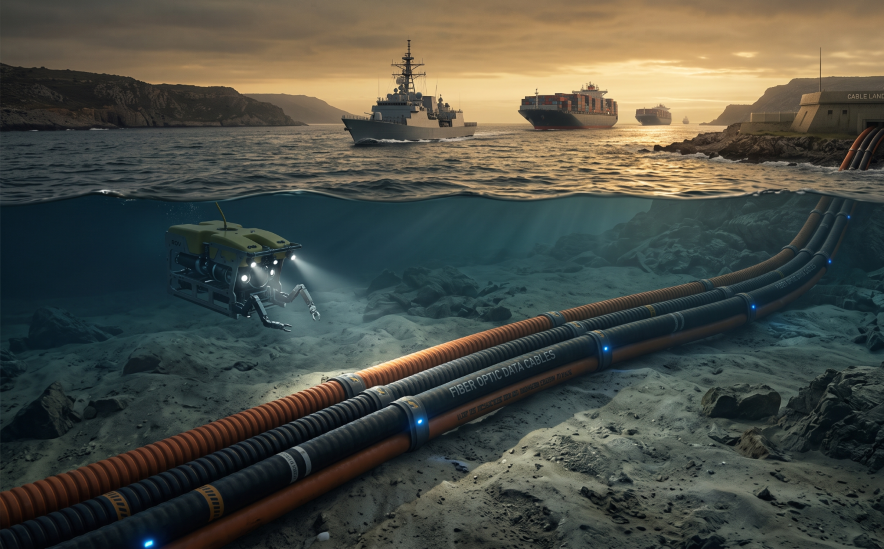
The Mechanics of Seabed Asymmetry
Submarine communication lines average 20 to 50 millimeters in diameter. While deep-ocean spans face minimal physical disruption, coastal transit zones present distinct strategic vulnerabilities:
- Shallow Water Exposure: Choke points such as the Luzon Strait, the Malacca Strait, and the Baltic Sea feature seabed depths under 100 meters, making fiber lines vulnerable to standard commercial anchors and bottom-trawling nets.
- The Attribution Gap: Proving whether a severed trunk was caused by maritime negligence or state-directed gray-zone sabotage requires weeks of hydrographic analysis, creating operational deniability for offending operators.
- Standby Fleet Constraints: The global repair fleet consists of fewer than 60 specialized cable ships worldwide. Coordinated or overlapping disruptions in a single theater can paralyze regional connectivity for months.
Multilateral Defense Strategies
Naval commands and regional coalitions are recalibrating their posture to classify subsea fiber as critical sovereign infrastructure:
1. Route Redundancy
New financing frameworks across the Quad (US, India, Japan, Australia) and European development banks are prioritizing non-traditional routes—bypassing contested straits in favor of deep-ocean circumvention paths and overland trans-regional corridors.
2. AIS Dark-Vessel Monitoring
Coast guards and allied naval patrols are pairing real-time satellite Automatic Identification System (AIS) tracking with automated telemetry to flag vessels that disable transponders near identified subsea landing points.
3. Integrated LEO Satellite Backups
Emergency response frameworks now incorporate automatic bandwidth failovers to Low Earth Orbit (LEO) constellations, ensuring government communications and emergency financial clearing remain active during physical cable outages.
Reader response